Stochastic System

Contents
The Stochastic Oscillator is a centered momentum oscillator. It is a percentile that shows a recent close in relationship to a high and low over a certain period of time. Stochastics were originally designed for stocks in a trading market. Although the parameters can be tweaked to give good results in almost any market, the default values reflect good results with stocks over the past 10 years.
Our built-in stochastic system uses convergence for signals. Positive convergence of a certain strength (called a swing factor), during a certain number of bars, and rising generate a long signal. The opposite exits a long position. Our system does not take short trades at all.
The conditions used to generate a long signal are as follows:
•There is a positive convergence that develops below a %K(Full) of 22.
•The %K(Full) is above 22 (this can be customized) and has started rising above %K(Slow) over the past 4 days.
•The convergence must take place over a certain time.
•The convergence must include highs and lows of a certain profundity to avoid meaningless signals.
The conditions for selling are much the same, except the convergence must be negative and falling below 78 (also customizable). Below are examples of both signals. Note the positive and negative convergences and rising or falling %K(Full).
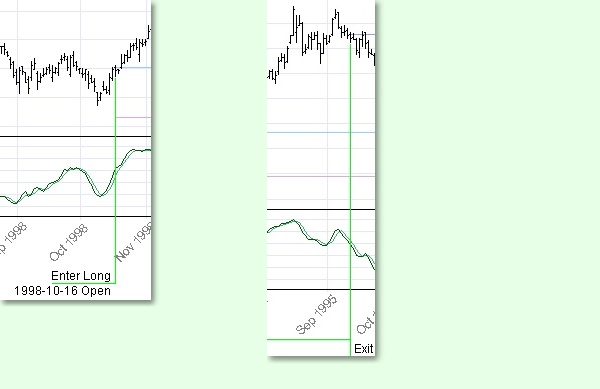
The following values are used for the Stochastic System. The values shown are the default values.
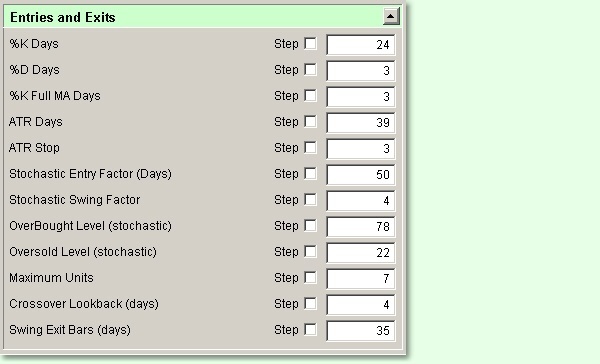
%K Days
The number of days used to determine %K(Fast).
%D Days
The number of days used to determine %D, a moving average of %K.
%K Full MA Days
The number of days used to smooth %K(Full).
ATR Days
The number of days used to calculate average true range.
ATR Stop
A factor used to determine stops based on ATR.
Stochastic Swing Factor (Days)
The number of days high and low stochastics are considered in determining convergence.
Stochastic Swing Factor
The depth, in stochastic units, that highs and lows must be from each other. If this is too high, only very large fluctuations will produce signals. If this is too small, insignificant variations will generate signals.
Overbought Level
The range, in stochastic units, that is considered overbought.
Oversold Level
The range, in stochastic units, that is considered oversold.
Maximum Units
The maximum units that may be in the long position at any one time.
Crossover Lookback (Days)
The number of days that a crossover between %K(Slow) and %K(Full) is looked for.
Swing Exit Bars (Days)
Akin to Stochastic Swing Factor (Days), except only used to exit a long position.
Entry Script
' We are looking for a specific pattern here
' A convergence at a certain over-sold level, with a cross over
IF stochasticHigh2 > overSoldLevel AND
stochasticHigh1 > overSoldLevel AND
stochasticLow1 < overSoldLevel AND
stochasticLow2 < overSoldLevel AND
stochasticKSlow > stochasticKFull AND
stochasticKSlow[crossoverLookback] < stochasticKFull[crossoverLookback] AND
stochasticLow1 > stochasticLow2 AND
stochasticHigh1 < stochasticHigh2 AND
instrument.bar - stochasticLow2Bar < swingEntryBars THEN
IF instrument.totalUnits < maxUnits THEN
IF useATRStops THEN
broker.EnterLongOnOpen( instrument.close - averageTrueRange * atrStop )
ELSE
broker.EnterLongOnOpen
ENDIF
ENDIF
ENDIF
Exit Script
' We are looking for an exit point -- opposite logic to the entry point
IF stochasticHigh2 > overBoughtLevel AND
stochasticHigh1 > overBoughtLevel AND
stochasticLow1 < overBoughtLevel AND
stochasticLow2 < overBoughtLevel AND
stochasticKSlow < stochasticKFull AND
stochasticKSlow[crossoverLookback] > stochasticKFull[crossoverLookback] AND
stochasticLow1 > stochasticLow2 AND
stochasticHigh1 < stochasticHigh2 AND
instrument.bar - stochasticLow2Bar < swingExitBars THEN
broker.ExitAllUnitsOnOpen
ENDIF
Adjust Stops
' ---------------------------------------------
' Enter stop if "Use ATR Stops" is true
' ---------------------------------------------
IF useATRStops THEN
FOR unitIndex = 1 to instrument.totalUnits
broker.ExitUnitOnStop( unitIndex, instrument.unitExitStop[ unitIndex ] )
NEXT
ENDIF
After Instrument Day Script
IF lookingForHigh = TRUE THEN
IF stochasticKFull > stochasticHigh1 THEN
'Finds new high
stochasticHigh1 = stochasticKFull
stochasticHigh1Bar = instrument.bar
ENDIF
IF stochasticHigh1 - stochasticKFull > swingFactor THEN
'The high found is significant based on swingFactor
lookingForLow = TRUE
lookingforHigh = FALSE
stochasticLow2 = stochasticLow1
stochasticLow2Bar = stochasticLow1Bar
stochasticLow1 = stochasticKFull
stochasticLow1Bar = instrument.bar
ENDIF
ENDIF
IF lookingForLow = TRUE THEN
IF stochasticKFull < stochasticLow1 THEN
stochasticLow1 = stochasticKFull
stochasticLow1Bar = instrument.bar
ENDIF
IF stochasticKFull - stochasticLow1 > swingFactor THEN
lookingForHigh = TRUE
lookingForLow = FALSE
stochasticHigh2 = stochasticHigh1
stochasticHigh2Bar = stochasticHigh1Bar
stochasticHigh1 = stochasticKFull
stochasticHigh1Bar = instrument.bar
ENDIF
ENDIF
Edit Time: 2/18/2022 3:35:42 PM |
Topic ID#: 208 |